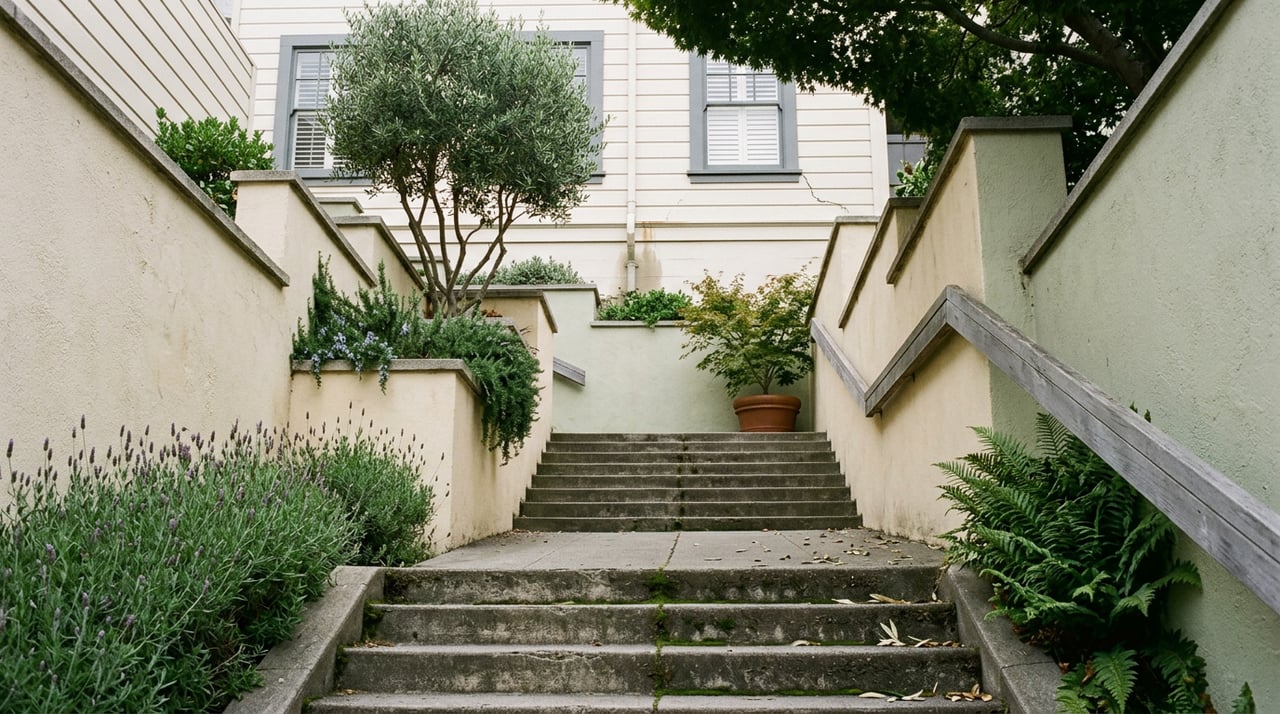
Most mornings this summer, the line for Lombard Street's crooked block forms before nine and doesn't thin until dusk. Two blocks over and about two hundred feet up, a different kind of upkeep is happening. A neighbor is coiling a garden hose along the balustrade of the Vallejo Street Steps, tending a planting bed that has nothing to do with any city department. That contrast, a tourist landmark on one side and a resident-tended stairway on the other, is the thing worth understanding about how Russian Hill actually runs in August.
The stairways that make this hill famous are not maintained by San Francisco Recreation and Parks. They're maintained by the people who live next to them, block by block, garden by garden. That single fact explains more about the texture of a walk here than any list of scenic viewpoints, and it has real consequences for anyone navigating the hill this summer, from a closed playground to a new bagel counter on Polk.
The Stairs Nobody Sends a Crew For
Russian Hill Neighbors, the volunteer-run association behind most of the hill's green infrastructure, is direct about how its stairway gardens work: they're maintained by individual associations, each one raising its own funds and doing its own regular upkeep. There's no unified parks crew rotating through on a schedule. The Vallejo Stairway Garden, which zigzags from Vallejo down to Taylor past a run of historic buildings, is kept up by different hands than the Chestnut Street Stairway Garden or the Greenwich Garden Path a few blocks away. Havens Place and Macondray Lane, the car-free lane widely understood to be the real-world model for Barbary Lane in Armistead Maupin's Tales of the City, follow the same pattern: neighbors plant it, neighbors weed it, neighbors decide how much bougainvillea is too much.
That decentralization is why one stairway can look freshly planted in July while another, a five-minute walk away, looks like it's waiting on volunteer hours. It's not neglect. It's simply a different association with a different fundraising cycle. Russian Hill Neighbors itself earmarks contributions toward specific projects, including Fay Park, Helen Wills Park, the Broadway Tunnel Project, Ina Coolbrith Park, historic preservation, and the Vallejo Stairs, which means the pace of any given stairway's upkeep is tied directly to how much a small, specific group of neighbors raised that year.
What Was Actually Closed This Summer
Francisco Park, the 4.5-acre park that opened on the site of a decommissioned 19th-century reservoir in April 2022, has its own quieter maintenance story. The reservoir was decommissioned in 1940, shut down entirely by 1966, and then sat unused until 2014, when the city's Board of Supervisors finally voted to hand the site over for parkland, a gift funded privately in the same tradition as Stern Grove and South Park rather than built on the city's own dime. Once finished, it came with a rainwater catchment system designed to save nearly 900,000 gallons of water a year, a scale of infrastructure that only exists because a small group of advocates pushed the project for years before a shovel went into the ground.
The park's playground closed from June 22 through late July this year for a resurfacing project replacing its safety surfacing. If you avoided the hillside portion of Francisco Park for most of the summer because of that, the closure should be behind us by now, though city resurfacing timelines have a habit of running long, so it's worth a quick check before you plan a trip up with kids in tow. What didn't close is Pepi's Dog Park, the fenced dog run on Bay Street. It's a separate structure from the hillside playground, and that distinction matters: the two features close and reopen independently, so a closure sign on one gate doesn't mean the other is off-limits.
The Neighbors Who Keep Showing Up
Russian Hill Neighbors has been doing this work since 1981, and its cleanup crews are a good window into how unglamorous the maintenance actually is. The group runs a recurring Saturday cleanup that meets at the northwest corner of Hyde and Filbert, where volunteers form crews at 9:30 a.m. over coffee from Saint Frank Coffee and donut holes from Bob's Donut Holes, then clean the surrounding blocks from 10 a.m. to noon. The dates have run roughly monthly all year, posted on Eventbrite and SF Station a few weeks out each time.
Separately, the association's Parks Committee runs a native-planting volunteer day, usually the third Saturday of the month from 10 a.m. to 1 p.m., rotating through different neighborhood parks. The focus is specifically on plants that feed butterfly caterpillars and native bees, extending a pollinator corridor through the hill rather than just filling beds with whatever looks tidy. No gardening experience is required. If you've walked past a park bed that looked freshly turned over and wondered who did it, this is almost certainly the answer, and it's an open invitation rather than a closed civic process.
The Walk Worth Doing Even If You've Lived Here for Years
San Francisco City Guides runs a free stairways tour that starts at the bottom of the Vallejo Street Steps, at Mason and Vallejo, on Saturdays at 10 a.m. The route weaves through the same private stairway gardens covered above, narrated by guides who work in details on architect Willis Polk and poet Ina Coolbrith, the namesake of the park the tour passes through. Because the hill's microclimates shift the route slightly tour to tour, no two walks are identical, which is a fair description of the neighborhood itself. The next date on the calendar is Saturday, August 29, led by guide Sean H.
A version of that same route, done on your own time, might look like this:
- Start at the base of the Vallejo Street Steps, at Mason and Vallejo.
- Climb to Ina Coolbrith Park, an 0.8-acre WPA-era park dedicated in 1941 on a hillside once called Inspiration Point, and rest at the Poet's Corner bench installed in 1984 by the Ina Coolbrith Circle, with a clear view toward the Bay Bridge.
- Cross to Macondray Lane and walk its short, car-free length.
- Finish on Polk Street for coffee or an early lunch.
That last stop has gotten more interesting this year.
The New Stop on Polk
A former Peet's Coffee location on Polk between Broadway and Vallejo shut down earlier this year as part of a broader wave of Peet's closures, and the space wasn't vacant for long. Bageletto, the bagel shop that opened in the Mission in 2025 and runs a production facility on 14th Street, confirmed in April that it would take over the Polk Street spot as its second outpost, aiming to open by summer. Local food coverage at the time described the neighborhood as a true bagel desert, a gap cofounder Kiki Theodorides seemed happy to fill. The shop's approach leans Italian as much as New York-style, with in-house cured meats built into sandwiches like a muffuletta, a roast beef, and a prosciutto cotto breakfast sandwich. Theodorides has also said the company isn't looking to expand further after Polk Street, which suggests this is meant to be a considered addition to the block rather than the start of a chain.
It lands on a stretch of Polk that already does a fair amount of the neighborhood's daily errands: Sorella near the crest of the street, with a kitchen led by chef Fernanda Baggio and overseen by executive chef Suzette Gresham, Amarena, which has served the neighborhood for more than two decades, and Saint Frank Coffee, the design-magazine-worthy café a few doors down. A small operator moving into a space a national chain walked away from is its own kind of local infrastructure story, not so different from a stairway garden kept up by the people who actually use it.
The Pattern, If You're Looking for One
None of this runs through a single city office. The stairway gardens are funded association by association. The cleanup crews are volunteers with donated coffee. The dog park operates on its own schedule, separate from the playground next to it. Even the retail turnover on Polk is shaped as much by which small operator decides to commit to a block as by any citywide trend. Russian Hill holds together because enough people who live here keep choosing to do the unglamorous parts of the work, one stairway, one Saturday, one storefront at a time.
If you're weighing a move within the neighborhood, or just trying to understand why one block feels more cared for than the next, that pattern is worth knowing before you make a decision. The Freeman Group tracks Russian Hill closely, alongside the rest of San Francisco, and is glad to talk through what a specific block's history and upkeep actually mean for a purchase. Let me guide you home.