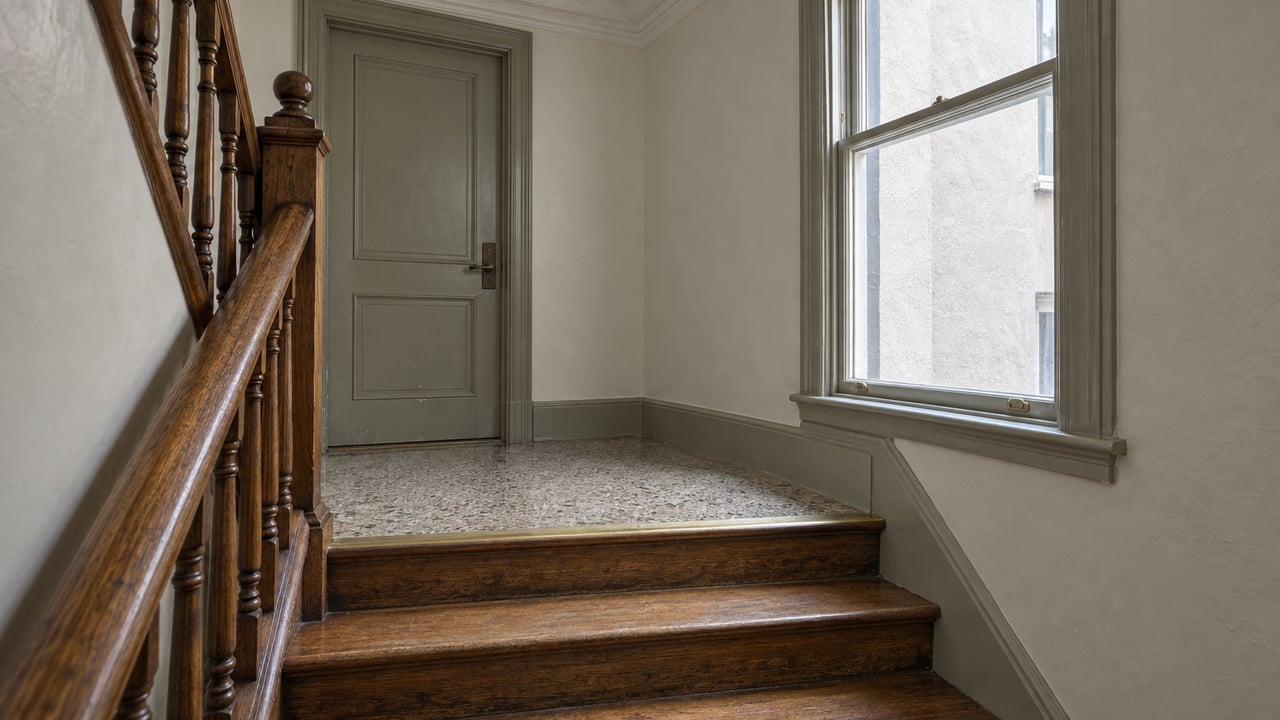
A buyer looking at two nearly identical two-bedroom flats on the same Mission block will sometimes find a $200,000 gap between them. Same era of building, same square footage, same exposure. One is a condo. The other is a tenancy in common, usually shortened to TIC, and it's priced to sell for meaningfully less.
The gap gets explained away as "TIC discount" and left there, as if it were a coupon. It isn't. It's compensation for a specific set of risks, and the risks are not the same from one Mission building to the next. A buyer who treats every TIC discount as equivalent is pricing risk incorrectly in both directions: sometimes overpaying for a building that will never convert, sometimes walking away from a discount that's actually fair for what it's compensating.
The friction shows up before any of that, though, at the financing stage, and it's the kind of detail that trips up buyers who assume a TIC purchase moves like a condo purchase.
The 23-Day Market Meeting a 45-Day Loan
Mission District homes have been selling fast. Over the three months ending in April 2026, the neighborhood's median sale price ran roughly $1.3 million, with homes going into contract in about 23 days on average, down sharply from around 40 days the year before. That's a market where sellers expect a tight, confident close.
A conventional condo loan in San Francisco typically closes in about 30 days. An individual TIC loan usually takes 45 to 60 days, because the lender isn't just underwriting the borrower. It's also reviewing the recorded TIC agreement, the occupancy schedule, the building's shared expenses, and the financial standing of the other owners in the building.
That mismatch is the first thing a Mission TIC buyer needs to solve, not the last. A buyer who writes an offer assuming a standard 30-day close, then discovers the lender needs an extra month, is negotiating a contingency extension against a seller who has other offers with cleaner timelines. The fix is to get pre-underwritten, not just pre-approved, by a lender who already works in TIC financing before the offer goes in. Pre-underwriting means the lender has reviewed the actual building documents and your file well enough to commit to a real closing date, rather than a generic estimate.
What a TIC Actually Is, in Plain Terms
A condominium gives you a separately deeded unit plus a share of an owners' association, governed by recorded bylaws called CC&Rs, short for Covenants, Conditions and Restrictions. A TIC gives you a fractional, undivided interest in the entire building. You don't own your unit as its own legal parcel. Your right to live in a specific flat comes from a private, recorded TIC agreement among the co-owners, not from a condominium map filed with the city.
That distinction is why TICs exist at all in San Francisco. Many Mission flats sit in Victorian and Edwardian buildings that were built with two, three, or four units and were never subdivided into legal condominiums. Rather than wait for the city's conversion process, owners sell fractional shares instead, governed by a private agreement that spells out expense allocation, maintenance duties, voting rules, and what happens when someone wants to sell.
It's also why the financing looks different, and why that difference has a price.
Where the Discount Comes From
Only a small group of lenders write individual TIC loans in San Francisco. Sterling Bank and Trust is the name that comes up most often, alongside the National Cooperative Bank, Bank of Marin, and Redwood Credit Union. None of the large national mortgage lenders touch fractional interests, because a TIC loan is secured by a share of a building rather than a separately titled unit, and that changes how the collateral gets appraised and how the lender values its position if a borrower defaults.
That narrow lender pool shows up in the terms. Redwood Credit Union's published rate sheet, effective September 18, 2026, shows a jumbo TIC loan on an $840,000 purchase at 60 percent loan-to-value pricing at 7.001 percent APR for a well-qualified borrower, a real, current data point rather than an estimate. Across the specialty lenders, individual TIC loans generally run a quarter to a full percentage point above a comparable condo loan, with down payments in the 20 to 30 percent range rather than the wider range condo buyers can plan around.
Here's how that stacks up against a comparable condo loan in the same building type:
| Condo loan | Individual TIC loan | |
|---|---|---|
| Typical down payment | Often 10 to 20% | 20 to 30% |
| Rate premium | Baseline | Roughly 0.25 to 1.0 point higher |
| Available lenders | Most banks and mortgage companies | A handful of specialty lenders |
| Typical closing timeline | About 30 days | 45 to 60 days |
| Appraisal comps | Deep pool of condo sales | Fewer direct TIC comps, more adjustment |
Add up the smaller lender pool, the rate premium, the bigger down payment, and the appraisal difficulty, and you get a discount most 2026 market data puts at roughly 10 to 20 percent below a comparable condo in the same neighborhood, sometimes wider. Applied to the Mission's roughly $1.3 million condo median, that range translates to something like $130,000 to $260,000 off a comparable TIC. Citywide data from earlier in 2026 shows TIC sales clustering specifically in the Mission and Mission Dolores, alongside Noe Valley and Eureka Valley, the Marina, and Nob Hill and Telegraph Hill, the same neighborhoods where condo pricing runs highest. That's not a coincidence. The discount is what makes those neighborhoods reachable at all for buyers who'd otherwise be priced out of a condo there.
None of that discount is free, though. It's the market's way of pricing in a financing process that costs more, takes longer, and carries more uncertainty than a condo purchase. The size of the discount should track how much of that uncertainty a specific building still carries, and that's where most buyers stop asking questions too early.
The Conversion Bet Nobody Should Assume
The biggest uncertainty in a Mission TIC purchase isn't the loan. It's whether the building will ever become a legal condominium, and San Francisco's path to that outcome has been stuck for over a decade.
In 2013, the city halted its annual condominium conversion lottery for buildings of three to six units and replaced it with a temporary Expedited Conversion Program, intended to let roughly 2,200 existing TIC owners convert over a defined window in exchange for a per-unit fee, while offering binding lifetime leases to any tenants in the building. That program ran until 2020 and is no longer accepting new applications. Legal analysts covering the ordinance predicted back in 2017 that the lottery would likely return by 2025 or 2026. A 2026 legal update on San Francisco duplex conversion rules was still describing the lottery as suspended, with a return window pushed out to sometime between 2024 and 2026, and no confirmed restart date as of this writing.
That leaves owners of three, four, five, and six-unit TIC buildings with no reliable timeline for conversion at all. It's a real possibility, not a promise, and a buyer pricing a 20 percent discount against an assumed future conversion is pricing in an event that has already blown past its own forecast return date at least once.
Two-unit buildings are a different story. San Francisco has kept a standing bypass rule that lets a duplex convert once both units have been separately owner-occupied for a defined period, typically about a year, without waiting on the lottery at all. A TIC discount on a two-unit Mission building where both owners already live in their units is compensating for a conversion process with a known, comparatively short runway. The same size discount on a four-unit building is compensating for a process with no scheduled return date.
That's the distinction that should drive how a buyer reads any specific Mission listing.
Sizing the Discount to the Building
Before treating a TIC discount as a deal, it's worth confirming a short list of building-specific facts, because they change what the discount is actually buying.
- Unit count. Two-unit buildings have a defined bypass path to conversion. Three-to-six-unit buildings are waiting on a lottery with no scheduled restart.
- Occupancy of the other units. A bypass conversion generally requires both units to be owner-occupied. If the other unit is a long-term rental, that path isn't available regardless of what the listing implies.
- Financing already in place. A building already set up with individual, fractional loans for each owner is a cleaner purchase than one still carrying a single shared mortgage across all owners, which complicates both your closing and any future refinance.
- The TIC agreement itself. Right of first refusal, transfer restrictions, rules on subletting, and how capital assessments get allocated all live in this document, and a lender will review it as closely as your own finances.
A discount that looks identical on paper can be pricing in very different things depending on how those four points shake out. The job isn't to find the biggest discount. It's to confirm the discount matches the risk that's actually sitting in the building.
A few questions that come up often
Will my Mission TIC eventually convert to a condo on its own? Not automatically. A two-unit building with both units owner-occupied has a defined bypass path. A three-to-six-unit building is waiting on a lottery that's been expected to return for several years running and hasn't yet. Treat conversion as a possible long-term benefit, not a plan.
Can I get a standard 30-year fixed mortgage on a Mission TIC? Some specialty lenders now offer fixed-rate TIC products, but the pool is small and the terms generally carry a rate premium over a comparable condo loan. Confirm current products with a TIC-experienced lender before assuming any structure is available.
Does the TIC discount get bigger or smaller when the market slows? It tends to widen in a soft market, since fewer buyers are willing to take on the financing complexity when overall demand is weaker, and it tends to compress when demand is strong across the board. That's worth factoring into any exit timeline before buying.
A TIC in the Mission can be a genuinely good way into a building type and a block that would otherwise sit out of reach. Reading the discount correctly, building by building, is what turns that opportunity into a sound purchase instead of a bet on a lottery that keeps not happening. If you're weighing a specific Mission listing and want a second read on what its discount is actually pricing in, William Freeman can walk through the building's documents with you before you write the offer.